Events
Finance
Who Signs Off on the AI Agent? 5 Takeaways for Finance Leaders from Accounting Summit 2026
.png)


Five takeaways from Accounting Summit 2026: who is accountable for AI agents in finance, why pilots stall, and what separates ROI from experiments.


At Accounting Summit 2026 in Düsseldorf (16–17 September), a large share of the AI sessions centered on control, ownership and proof, not on whether the technology works. Our own sessions pointed the same way: start with one high-impact use case, settle ownership before go-live, capture the expert knowledge that classic automation misses, and focus on fewer, better initiatives.
Two days, several stages, dozens of sessions. Between AI agents, e-invoicing mandates and S/4HANA deadlines, a few themes kept coming back. We attended as a sponsor with a booth and three masterclasses, one on our own and two together with our partners KEYE and EY. Here is what we took home.
Capability was less of a debate this year. One session in the program looked back at a 2023 prediction that AI would only help with routine accounting tasks. The speaker now calls that prediction wrong, and a survey of accountants and controllers lists coding, account reconciliation and close commentary among the tasks AI has taken over.
If capability is largely settled, what replaced it as a key theme? Control. Across several sessions, the program pointed to the same ideas:
The takeaway: Across these sessions, auditability came up as a recurring condition for AI in finance. Whether you can explain an agent’s decision to your auditor comes before what the agent can do.
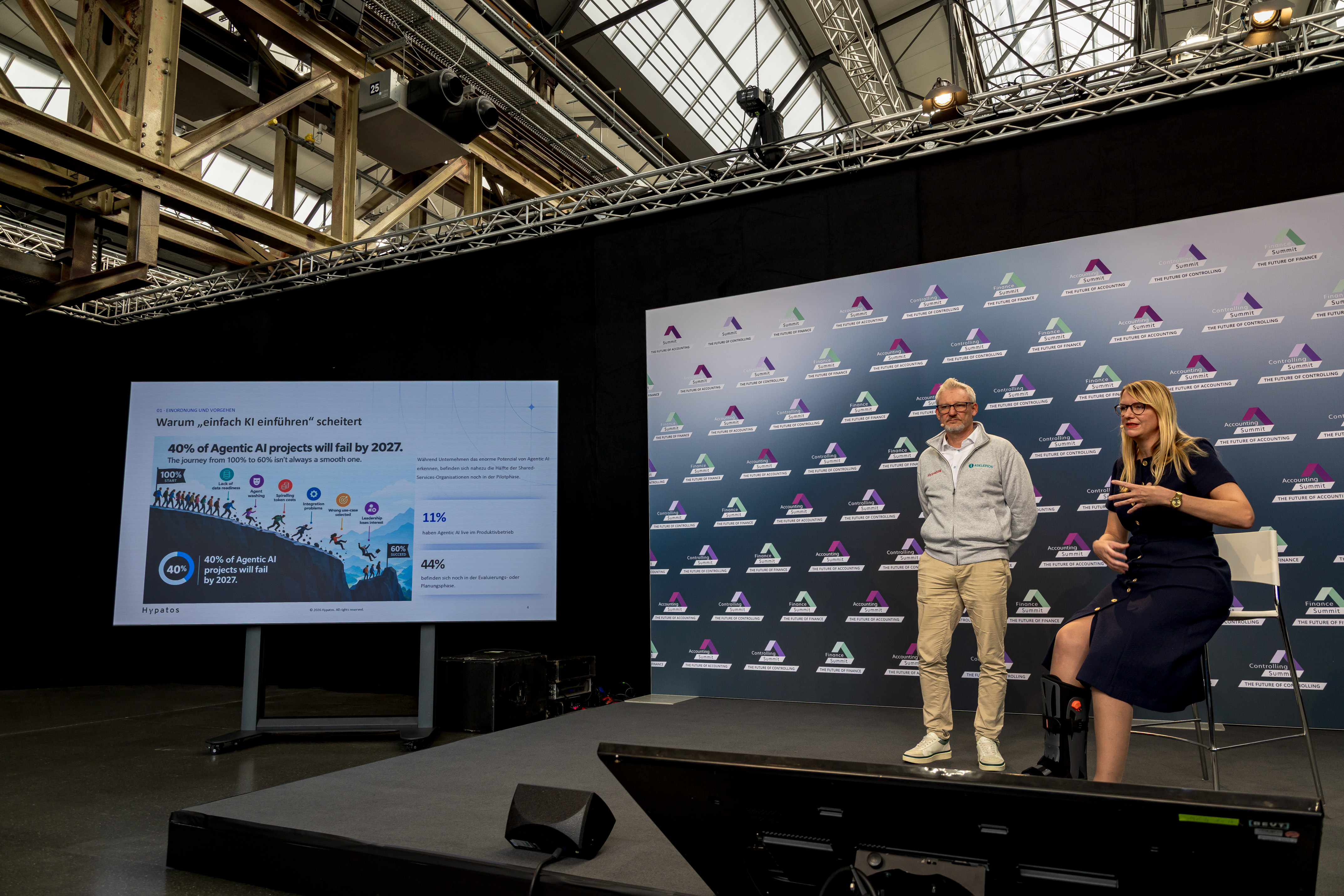
In the masterclass “From Use Case to ROI”, Judith Leopold (Principal, Digital Finance AI Transformation, KEYE) and Georg Stumm (Strategic Account Executive, Hypatos) started from a sobering number: only 11% of shared-services organizations run agentic AI in production, while 44% are still evaluating or planning. The audience clearly found the session useful, and both speakers received an Accounting Summit Speaker Award for it.
Their recommendations for a fast path to ROI came down to three decisions:
They also described early warning signs that a project is off track: stalled adoption, data gaps and unclear responsibilities. Governance is easiest to set before go-live, with a named business owner, a process owner and an application owner, among other roles.
The program shows that other sessions looked at the same problem from the leadership and organizational side. Julia Kreft (Syntegon) referred to studies according to which up to 70% of transformation initiatives fail, and focused on leadership behavior and psychological safety. Verena Klaebe (Best Secret Group) examined how unclear process ownership between business, IT and finance, and governance built for control rather than change, slow transformations down.
The takeaway: Settle ownership before go-live. The 90-day path we presented (30 days each for design, build and testing) assumes that has been done.

Maximilian Geigis (VP Product, Hypatos) opened with an observation most accountants will recognize: accounting is knowledge-intensive expert work. It requires knowing the standards and the tax rules, and also the company context, such as which entities, suppliers or customers get special treatment, and what to do when no clear rule exists.
His argument was that knowledge leaks out of finance organizations in four ways:

Classic automation made this worse, not better. Max described how expert knowledge was transferred through interviews and workshops to an implementer, who translated it into rules, derivation tables or RPA steps. Part of the knowledge was lost in that translation, and because the real process keeps changing, the automation lagged behind it.
What changes with AI agents? Max described an implementation that looks more like onboarding a new colleague: experts provide guidelines, documentation and examples, and the agent can read and apply them without translation into if-then rules. Historical postings and the chart of accounts can teach it the reasoning behind decisions, not just the outcomes. Corrections can be given in natural language.
His demo made one point especially well. An agent’s account coding can rest on historical postings, but history isn’t infallible, because past postings can be wrong and rules change. Relying only on historical patterns is essentially the classic machine-learning approach. When an accountant spots a wrong coding, they explain what was wrong and why. The system checks whether the explanation conflicts with existing knowledge and proposes a knowledge entry. Once a human approves it, the correction becomes reusable knowledge for every similar future case.
The KEYE session put numbers on the same effect. In a European hospital group, rule-based technology had capped PO invoice automation at 54% while non-PO invoices were at 0%, because routing them needed judgment. After go-live, PO automation reached 97% and non-PO invoices 86%.
The takeaway: Before choosing a tool, ask where your team’s judgment lives and whether it’s written down. Every exception your best accountant handles from memory is a process step your automation can’t see, and a risk when that person leaves.
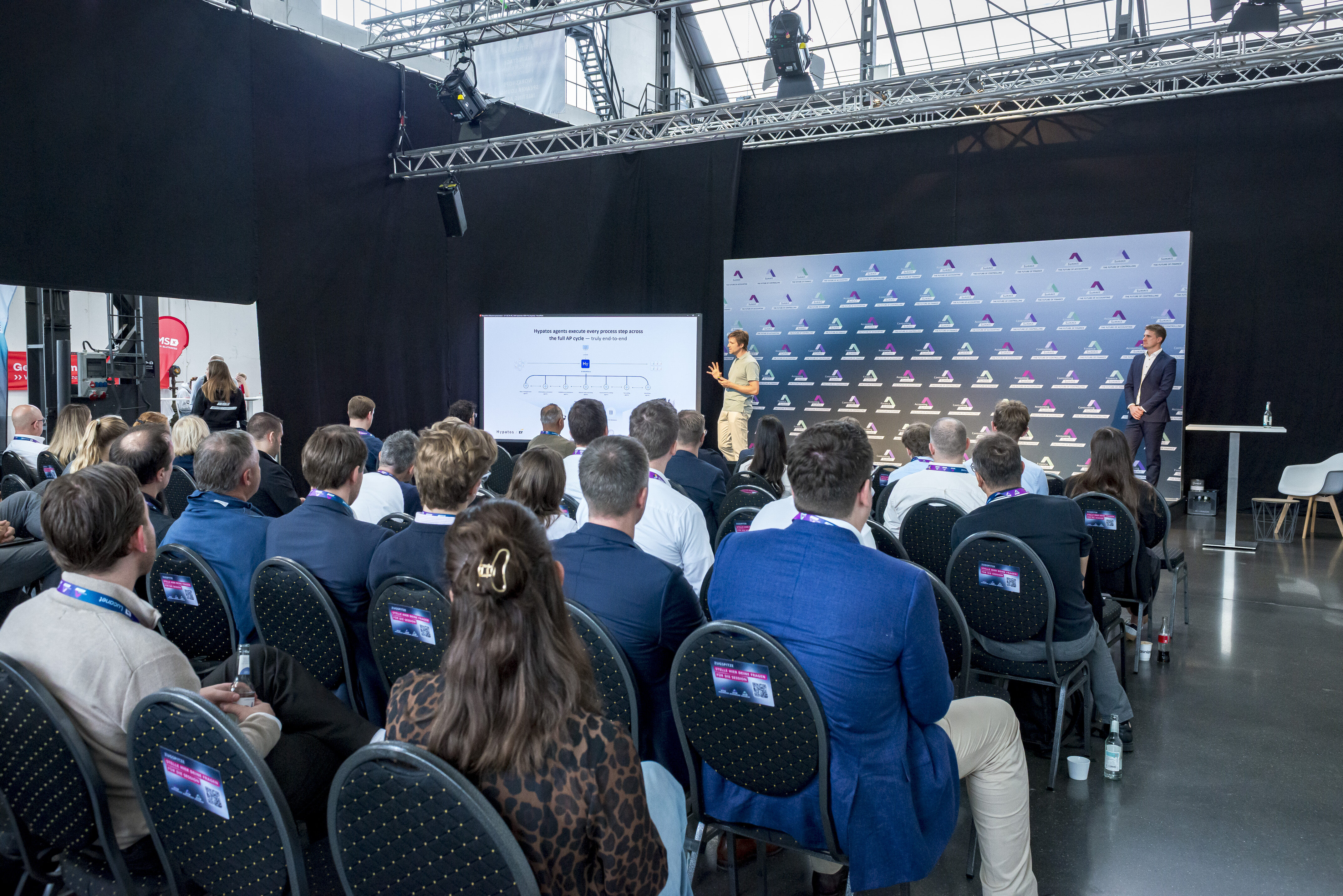
In the masterclass “The 90% Shift”, Tobias Eisenbart (Senior Strategic Value Consultant, Hypatos) and Christopher Rautzenberg (Partner, EY) asked why AP invoices still reach someone’s desk after years of automation. The answer was five specific gaps, not “AI isn’t good enough”:
A global fashion and retail group with 78 markets and roughly 800,000 invoices a year shows what changes when these gaps close. It reported a 40% capacity gain in its shared service center, a 75% reduction in incorrect and duplicate invoices, and end-to-end automation above 80%, including autonomous VAT validation.

The session also covered the foundations for an agentic AI workforce: technology, people, process, and compliance and governance. The advice on people was direct. Be honest about the change, including which jobs will go away. And don’t just map existing processes. Reimagine them for an agentic future and write work instructions to suit.
The takeaway: Diagnose your own blockers before you buy anything. Most teams can tell within an afternoon which of the five applies to them, and that shows where automation pays back first.
Three themes pointed toward the future:
Regulatory data also came up as a foundation. Archit Gupta (Cleartax) covered why e-invoice data could become the missing foundation for finance AI, and Julian Pauli (Vertex) explained why e-reporting, real-time reporting obligations and tax determination are the next step after e-invoicing.
The takeaway: In the finance function our sessions described, the open questions concern decisions: what to automate, who owns it, what the agents know and what to stop.
About 90 days for a focused use case, split into design, build and testing, with ownership and governance defined before go-live.
For large, mission-critical processes, building in-house often takes 18 months or more. Pre-built agents adapted to your work instructions usually reach ROI sooner.
From historical postings, policies, process documentation and the expertise of your accountants. Feedback given in natural language can be turned into reviewed, approved knowledge that the agents reuse.
It gets invoices in the door in a structured format. The savings only come when the data is checked, coded and routed into your ERP automatically.
If you’d like the presentations from our three masterclasses, just reach out and we’ll send them over. And if you want to go even deeper, get in touch to schedule a demo and see how it works with your own use case.
Further stories from our blog


